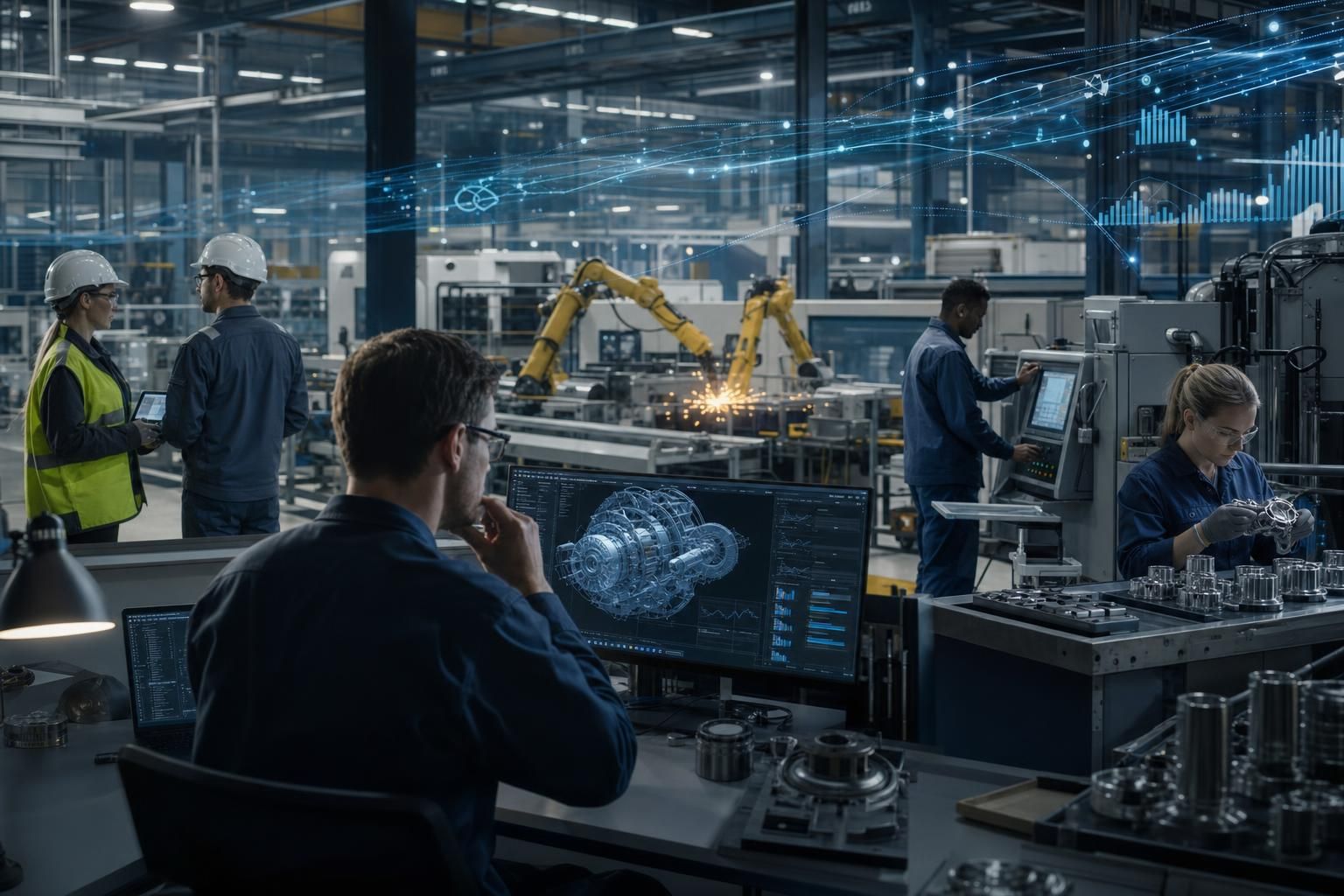
How Manufacturers Can Work Smarter by Applying AI
Manufacturing has always been built on efficiency, precision, and the ability to make good decisions quickly. AI does not replace those fundamentals — it accelerates them. For manufacturers looking to stay competitive, understanding where AI fits into daily operations is less a technology question and more a business strategy question.
This article walks through the practical ways AI can increase productivity on the shop floor and across the back office, while making the case for why human involvement remains a non-negotiable part of any successful implementation.
What AI Actually Does in a Manufacturing Context
At its core, AI in manufacturing refers to software systems that can process large volumes of operational data, recognize patterns, and surface recommendations or automated actions faster than a person could do manually. It is not a single tool — it is a layer of intelligence that sits on top of your existing processes.
Practical applications commonly fall into a few categories:
- Production scheduling optimization — AI can analyze machine capacity, order queues, material availability, and labor shifts to recommend production sequences that minimize downtime and maximize throughput.
- Supply chain and purchasing visibility — By continuously monitoring supplier lead times, inventory levels, and demand signals, AI helps purchasing teams anticipate shortages before they cause line stoppages.
- KPI monitoring and anomaly detection — Rather than waiting for a weekly report, AI-driven dashboards track operational KPIs in real time and flag deviations the moment they appear.
- Financial intelligence — AI can surface cost trends, margin pressures, and budget variances across departments so finance and operations teams are always working from current information.
These capabilities align closely with the areas where manufacturers most often lose time and money: inefficient scheduling, reactive purchasing, lagging visibility into performance, and slow financial feedback loops.
Why Productivity Increases When AI Is Involved
Productivity in manufacturing typically hinges on two things: keeping machines and people busy with the right work, and removing the friction that slows decisions down. AI addresses both.
When scheduling is optimized by an intelligent system rather than managed through spreadsheets or tribal knowledge, production flows more predictably. Jobs are sequenced based on real constraints rather than guesswork, and planners spend less time firefighting and more time looking ahead.
On the purchasing side, having clear visibility into what is being ordered, at what price, and from which suppliers means fewer emergency purchases, better negotiating leverage, and less capital tied up in excess inventory. AI makes that visibility continuous rather than periodic.
For operational KPIs, the productivity gain comes from speed of insight. When a metric trends in the wrong direction, teams that know about it in hours rather than days can course-correct before a small problem becomes a costly one.
Precision Without Perfection: Why Humans Must Stay in the Loop
This is perhaps the most important point in any honest conversation about AI in manufacturing: AI is precise, but it is not infallible. It works with the data it has been given, and it optimizes for the objectives it has been set. That means it can be confidently wrong when data is incomplete, when conditions change unexpectedly, or when the right decision requires judgment that goes beyond the numbers.
Experienced operators and managers bring context that AI cannot replicate. They know when a supplier's lead-time estimate is unreliable. They recognize when a KPI anomaly is a data entry error versus a genuine production issue. They understand the human dynamics of a shift change that no algorithm can fully model.
The practical implication is straightforward: AI should be treated as a highly capable analyst and recommender, not as an autonomous decision-maker. Build workflows where AI surfaces insights and recommendations, and where qualified people review, validate, and act on those recommendations. This human-in-the-loop model captures the speed and pattern-recognition strengths of AI while preserving the judgment and accountability that good manufacturing operations require.
Where to Start: Applying AI Across Manufacturing Operations
For manufacturers who are earlier in their AI journey, the most effective approach is usually to start with visibility before moving to automation. Here is a practical sequence many operations follow:
Step 1 — Centralize Your Operational Data
AI is only as good as the data it can access. Before any intelligent layer can be meaningful, production data, purchasing records, financial figures, and KPI inputs need to flow into a single source of truth. Fragmented data across disconnected systems is the most common barrier to effective AI adoption.
Step 2 — Establish Baseline KPI Monitoring
Once data is centralized, set up dashboards that track the metrics your team already cares about. This is the foundation of operational intelligence — knowing what is happening across scheduling, purchasing, and finance in real time, rather than reconstructing it after the fact.
Step 3 — Introduce Optimization Tools in High-Friction Areas
Scheduling is often the highest-impact starting point because inefficiencies there cascade through the entire operation. Applying AI-driven scheduling optimization to even a portion of the production calendar can surface meaningful improvements in throughput and resource utilization.
Step 4 — Extend Intelligence to Purchasing and Finance
With scheduling visibility in place, extend the same data-driven approach to purchasing workflows. Purchasing visibility tools help teams see committed spend, supplier performance, and inventory exposure in one view. Finance tools then allow leadership to connect operational performance to financial outcomes without waiting for month-end close.
Step 5 — Build a Culture of Human-AI Collaboration
Tools succeed or fail based on adoption. Involve the people who will use AI recommendations daily in the rollout process. Train them not just on how to use the system but on when to trust it and when to question it. An operations team that understands the logic behind AI recommendations will use them far more effectively than one that treats the output as a black box.
The Business Case for Acting Now
Manufacturers who delay AI adoption are not standing still — they are falling behind competitors who are already shortening lead times, tightening purchasing costs, and making faster operational decisions. The barriers to entry have dropped considerably: modern operational intelligence platforms are designed for manufacturing environments and do not require a dedicated data science team to operate.
The question is not whether AI will change how manufacturing works. It already is. The question is whether your organization will shape how it enters your operation or react to the consequences of not having it.
For most manufacturers, the right answer is a focused, phased approach: start with better visibility, layer in optimization where the friction is highest, and maintain rigorous human oversight throughout. That combination — intelligent tools plus experienced people — is where the real productivity and precision gains live.
Final Thought
AI in manufacturing is not about replacing the expertise and judgment your team has built over years. It is about giving that expertise better information, faster. When your schedulers, purchasing managers, and financial leaders can see what is happening in real time and act on AI-powered recommendations they trust, the entire operation becomes more responsive, more precise, and more competitive.
The technology is ready. The opportunity is real. The key is implementing it thoughtfully, with people at the center of every decision it informs.